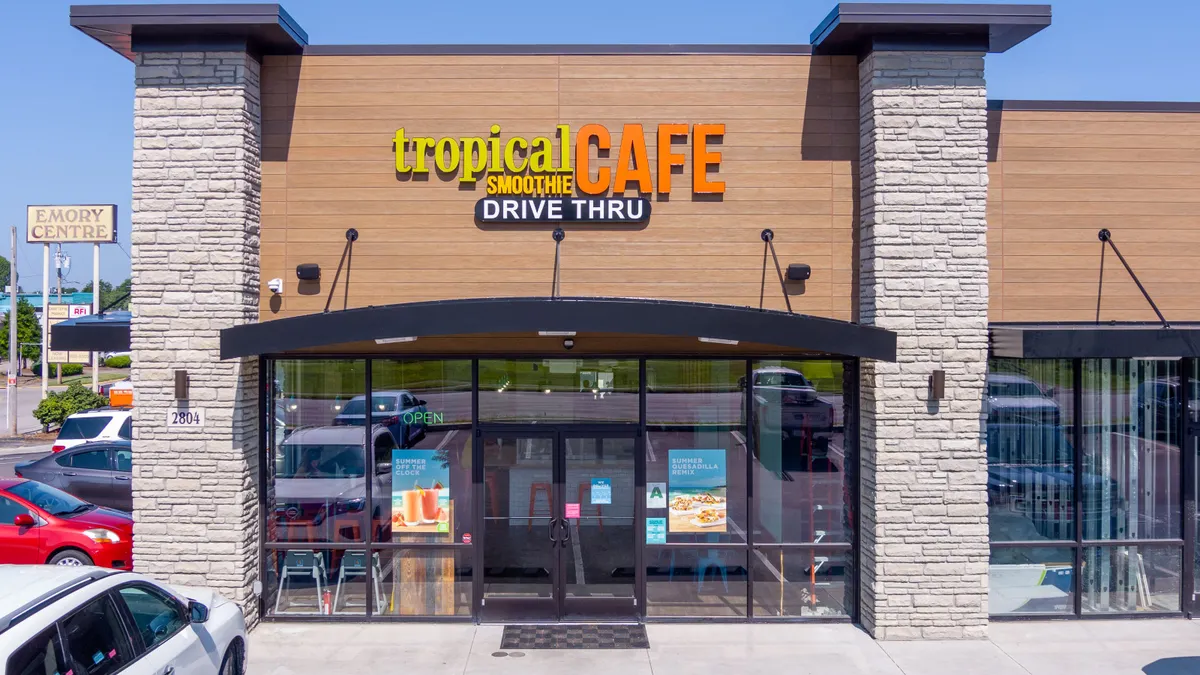
Tropical Smoothie Cafe CFO Chris Sasser considers himself a CX champion.
It's an uncommon sight to see CFOs preaching the gospel of CX, but Sasser has good reason to. The finance executive arrived at the restaurant chain with a background in marketing analytics and practice diving deep into guest experience.
“The way that we look at it, it's not really a marketing initiative, particularly within the restaurant business,” Sasser told CX Dive. “It's more of a business performance driver.”
While few finance executives understand the value of CX, the practice is “a proven lever for building business value,” Jon Picoult, founder and principal of Watermark Consulting, said in an email. “That’s because a great CX hits a company’s income statement in two places — helping to both raise revenues and control, if not reduce, operating expenses.”
In the restaurant business, it’s a differentiator.
The restaurant industry over the past six years has become a more competitive space, and restaurants are looking for where they can get ahead.
“As a CFO, we're always looking for areas where we can create sustainable, profitable growth, and in particular, guest experience is one of those ways that we could get guests to come back more often, spend more often and recommend us to others,” Sasser said. “So that really shows up in the metrics that I really do care about: traffic, franchisee profitability and long-term value.”
Tropical Smoothie Cafes used OSAT scores to measure overall satisfaction. The top 50% reported satisfaction about 17% higher and traffic that's 1.3% higher year to date than the bottom 50%.
“Being able to cut that information really allows us to add value, and ultimately gets the entire C-suite on board, myself included,” Sasser said.
It begins with a hypothesis
Tropical Smoothie Cafe found that a half-star improvement in a single location's Google rating translated to roughly $60,000 in incremental profit per year for the cafe owner.
Build that out, and a half-star improvement applied across the chain’s more than 1,700 locations represents a $100 million opportunity.
“It seems relatively intuitive, but it all starts with a hypothesis,” Sasser said. “The thought was, Google stars are the front porch of our cafes or our restaurants, and ultimately the first thing the guest sees when making a decision. So increasing those star ratings seems like it would be pretty important.”
Tropical Smoothie Cafe analyzed the star ratings, controlled for designated marketing areas, and looked at the performance of the cafes. The team asked: When a cafe has a higher Google star rating, what does that do to sales?
“And what we saw, on average, when you do get that half a star rating, you get 12% more sales, and that leads to quite a bit of flow through and additional profitability, which is quantified in that larger number,” Sasser said.
The team found the big threshold is four stars, as potential customers looking for restaurants on Google will filter four stars and above.
“Once we get guests in, we do a pretty good job of making them happy,” Sasser said. “But the new guests were the ones that were really trying to acquire with the Google rating.”
What held Google star ratings back
Tropical Smoothie Cafe has rapidly grown, opening about 750 stores in the past five years. That rapid growth led to some franchisee inconsistency, Sasser said.
“When we start looking at guest experience data in particular, it really allows us to figure out areas that we need to focus on with the franchisees, and points out those that may be underperforming,” Sasser said. “That's kind of the big draw for me from the data.”
Speed was the top issue impacting the chain’s Google reviews and overall satisfaction.
“We were able to triangulate that down to our food line, and ultimately we made some big investments in the back of house in order to get faster,” Sasser said.
While changes eventually lead to improving Google stars, the Google star ratings offer “a trailing indicator,” Sasser said.
It takes time to get reviews on Google, so Tropical Smoothie Cafe looks at other indicators on a day-to-day basis: speed and friendliness.
Via Qualtrics, the restaurant chain scrapes social media commentary and feedback from its receipt survey and looks for keywords indicating how the cafes are performing on those two factors. Equipped with that data, field business consultants inform individual cafes where they’re seeing slippage in friendliness and speed and help the locations make changes, from readjusting shifts to offering coaching opportunities.
“This year, the metric that we're focused on is Google reviews,” Sasser said. “The first place we start is trying to get that star rating up above four and ultimately drive more reviews across the system." That accounts for roughly one-quarter of field business consultants' compensation and bonus model.
The industry has become increasingly competitive, and customer retention is a big part and keeping guests happy ultimately is going to drive bottom line profitability, Sasser said.
“The food alone just isn't enough to bring guests in,” Sasser said. “It's the overall experience.”