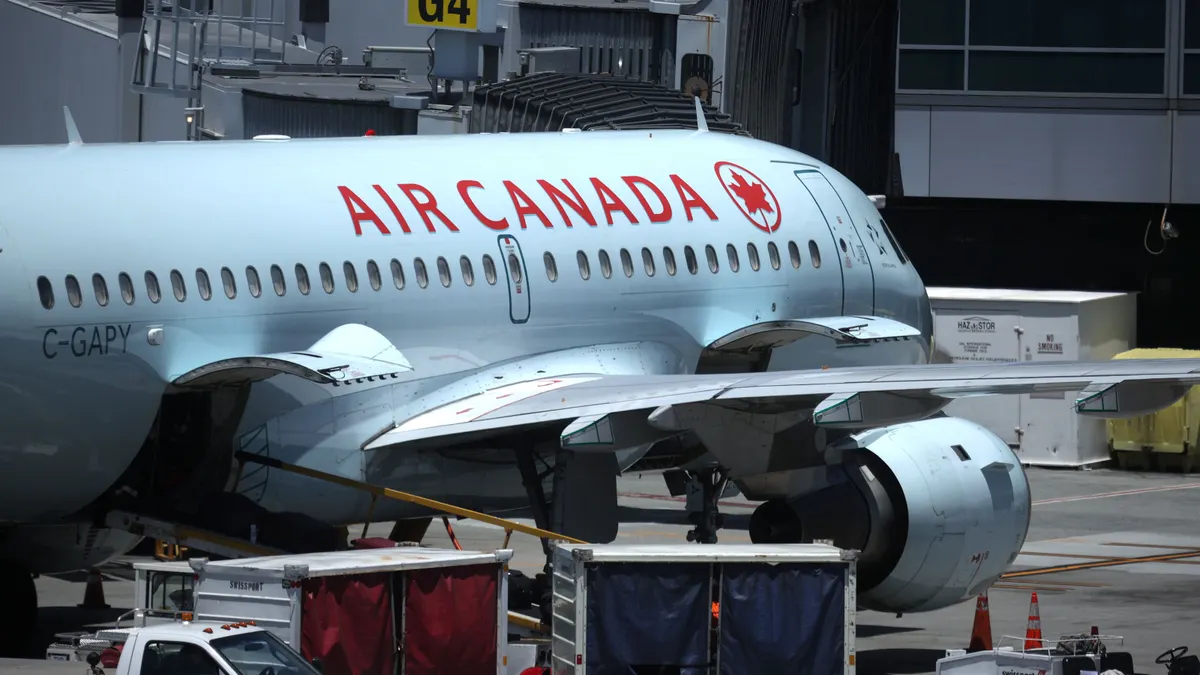
When Air Canada announced in August that it was selling one-quarter of its loyalty program for 2.5 billion Canadian dollars, or $1.75 billion, to pay down debt, it caused a stir throughout the airline industry, with some investors asking whether other brands would replicate such a plan.
Private equity firm Blackstone and Canadian pension fund La Caisse are leading the purchase of one-quarter of Aeroplan, in a deal that values the entire loyalty program at CA$10 billion — nearly $7 billion. Two Canadian pension funds, PSP Investments and British Columbia Investment Management Corporation, are also taking part. Air Canada will keep a 75% stake and run the program day to day.
The deal lets Air Canada raise cash against Aeroplan without giving up control, and the airline says members won’t notice a difference.
“Under the new partnership, Air Canada retains full control of the program, meaning partners, members, and employees can all expect full continuity of the program as they do today,” Craig Landry, Air Canada's chief innovation officer and president of Aeroplan, said in a news release.
Most of the money — about CA$1.7 billion or $1.2 billion — will pay off bonds coming due, while up to CA$800 million or $560 million will fund stock buybacks. The deal allows the airline to pay off debt without burning through its cash reserves.
“It provides additional financial flexibility, and supports our pursuit of an investment grade rating,” Air Canada CFO John Di Bert said in a news release.
The estimated value of the Aeroplan loyalty program is nearly double the airline's stock market value. That suggests investors have been undervaluing Air Canada and explains why the airline is buying back stock.
“It highlights the value of these loyalty programs, the tremendous value that, frankly, we are not seeing in our share prices,” United Airlines CFO Michael Leskinen said during the company’s Q3 2026 earnings call when asked about Air Canada’s partial sale of its loyalty program.
The gap isn’t surprising, as investors have long valued loyalty programs as businesses in their own right, especially in the airline industry, where loyalty programs have higher margins than transporting people and cargo, said Bart Biggers, partner and co-leader of the global aviation and airlines practice at Sidley Austin.
The deal also lets Air Canada buy the stake back in five to eight years.
“It's a financing and valuation move,” Biggers said. “It's not them retreating from loyalty.”
But maintaining control of Aeroplan is crucial for Air Canada.
“You want to keep control of it because it’s the most important asset,” Biggers said. “If you get the ability to do a callback on it, then it's kind of the best of all worlds.”
Air Canada tried this before
In 2005, Air Canada sold its entire loyalty program to Aimia, which operated it on the airline's behalf for more than a decade. Air Canada had exited the loyalty business entirely by 2008, then paid CA$450 million and assumed about CA$1.9 billion in liabilities to buy it back in 2018.
“The Toronto operation of Aimia was running their program, so everything from call center to tracking your frequent flyer miles to redeeming your free flights,” said David Slavick, co-founder and partner at Ascendant Loyalty Marketing, who advised the carrier when it weighed renewing that partnership.
Now, one-quarter of Aeroplan is worth more than what Air Canada paid to buy it back in its totality.
It suggests that airlines, as well as other travel and hospitality brands with strong loyalty programs, are usually better off maintaining control because they are core to their brand’s value proposition, said Neil Mittal, managing director, partner and head of the travel and transport practice in the Americas at L.E.K. Consulting.
“The real downside is if you sell off your entire program,” Mittal said. “Because it’s very symbiotic with the operations of the airline, which is why I think Air Canada rebought that program back in the day.”
Is such a loyalty program sale replicable?
Airlines often follow in a herd. But the Air Canada deal isn’t the start of a trend, as experts say these deals are situation-specific.
“I wouldn't call this a trend. You saw it happening during COVID because a lot of these airlines need to find ways to raise capital,” Mittal said. “I don't think this is the type of thing where a bunch of airline programs are going to start selling themselves off.”
But it does indicate that brands with valuable loyalty programs won’t give up control easily.
“I think we'd expect more structured monetization like this rather than outright sales,” Biggers said.
When asked on an October earnings call about whether Delta had anything to learn from Air Canada, Delta CEO Ed Bastian was firm that Delta would remain in control of its loyalty program.
“I'm really reticent to put a third-party, a financial investor between us and our best customers and preference,” Bastian said on the call. “At some point in time, this company very well may consider that as the best opportunity for shareholder value creation. But we're doing a pretty good job, I think, to date of shareholder value creation.”
Regardless, brands must choose the right partner and structure the deal to ensure the loyalty program's long-term success. While reducing members’ benefits can help boost near-term profitability, short-term thinking can also kill the goose that laid the golden egg.
Or, as Biggers put it, “The program is only as good as the members’ trust.”