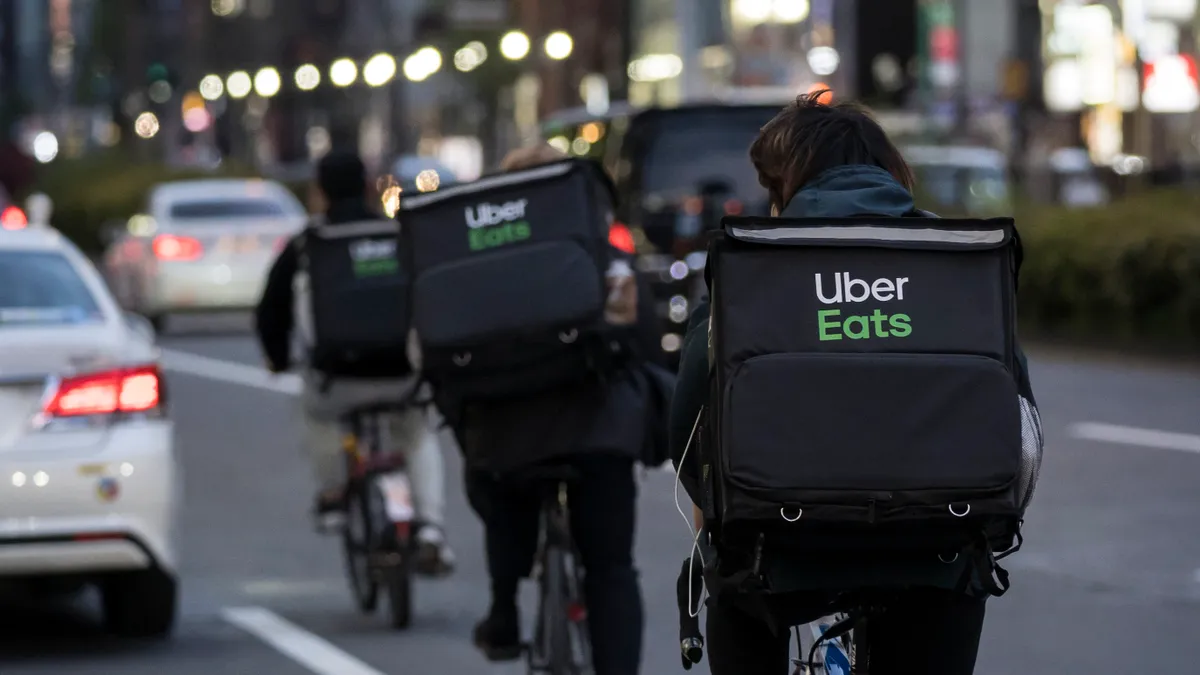
A California law that requires food delivery companies to provide customers with a human customer service representative went into effect last week.
The legislation also requires food delivery companies to provide a refund with the option of the refund in the form of original payment if the wrong order is delivered or if a delivery goes undelivered.
“When orders go wrong, customers deserve transparency and real support: not hidden fees or automated runarounds," Assemblymember Rebecca Bauer-Kahan said in an Instagram post last week.
As companies like Uber Eats, DoorDash, Grubhub and Postmates exploded in popularity, they relied on automation to address customer service complaints.
The California law puts guardrails around how food delivery companies handle service issues and to what extent it can rely on automation. Bauer-Kahan introduced the bill last year and California Gov. Gavin Newsom signed it into law in October.
While food delivery platforms will still be able to use automated systems to address customer service concerns, if automation is unable to address the issue, platforms must provide customers the ability to promptly connect with a human representative.
The legislation challenges deflection-first AI strategies that have dominated customer service for years and could be a sign of things to come in the industry, according to Vasili Triant, CEO of UJET, an AI-powered contact center platform provider.
“This should worry all customer service leaders who have misapplied AI where their customer cannot get access to something as simple as a refund without becoming incredibly frustrated,” Triant said in an email. “Because now it’s not just an unhappy customer, but a potential regulatory consequence when AI doesn't work.”
That’s not to say companies shouldn’t use AI and automation where it makes sense, according to Jeff Fettes, CEO of Laivly, an AI platform for contact centers. But companies can’t roll out AI to just deflect and must make sure it can roll out AI solutions that will successfully address consumer complaints.
“The moment AI starts making customer decisions, trust becomes the product,” Fettes said in an email. “If it’s approving refunds or handling disputes, it has to recognize edge cases, escalate when needed and explain its decisions — human in the loop or not.”
California is ahead of the rest of the country in regulating AI, but that doesn’t mean companies should sit on their haunches, experts say. The onus is on companies to institute strong AI governance.
“Regulation can help, but AI is moving faster than government can right now, which makes it incumbent on brands and AI companies to lead with strong governance if they expect to earn public adoption,” Fettes said.