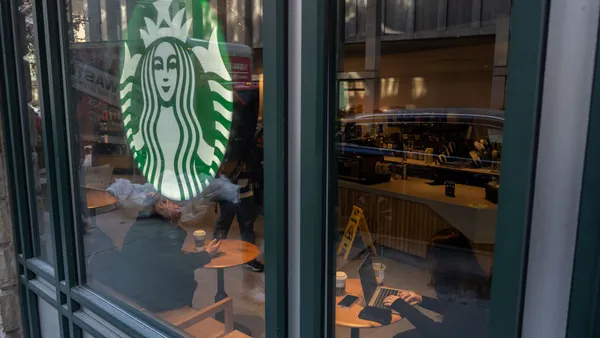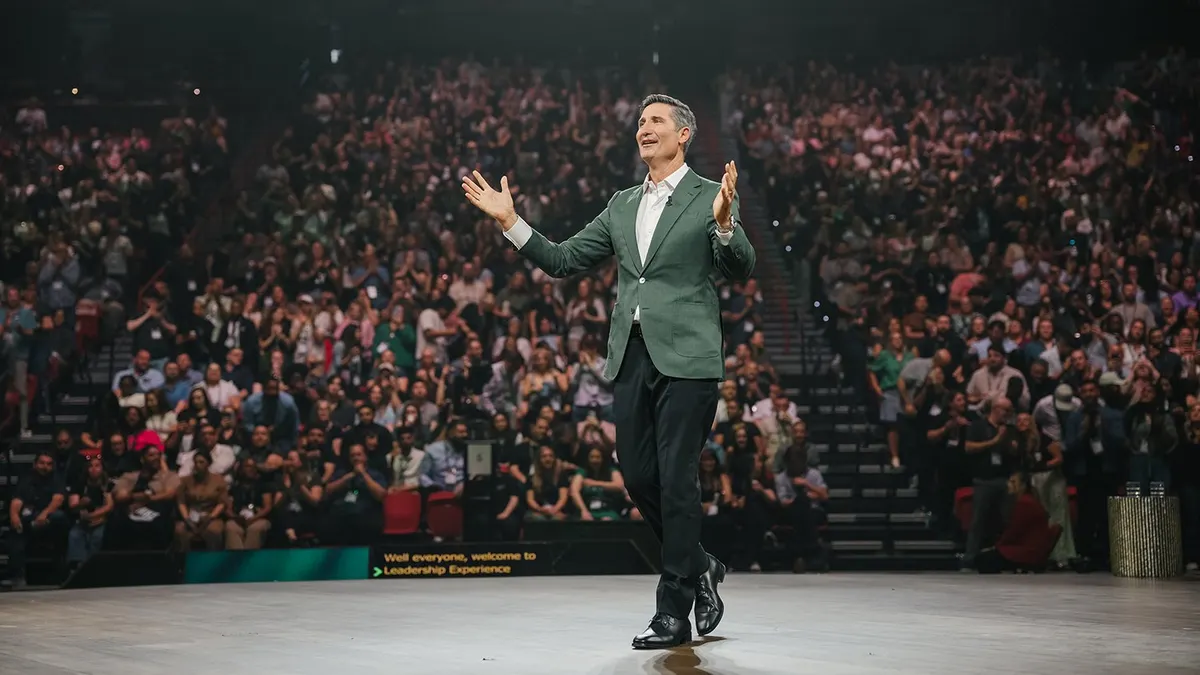

WASHINGTON — Brian Niccol sees Starbucks’ focus on the on-premise consumer experience and premium branding as key to promoting the brand’s off-premise business, rather than compete with it.
Speaking at the Wall Street Journal’s CEO Council Summit in Washington on Tuesday, Niccol said that about 60% of Starbucks’ transactions include an in-store element, split roughly evenly between in-person orders and mobile-order-and-pay. Forty percent of orders come through drive-thru channels.
“That's why I think it's so important for you to have that experience, when you come into the cafe,” Niccol said. Under Niccol, the company’s strategy has hinged on that on-premise experience, from the reintroduction of the coffee condiment bar to a $500 million investment in hourly labor and an ongoing $150 million remodel drive.
Those changes are meant to strengthen consumer experience, and Niccol said he wants the chain to win by becoming “the defining customer service company in the world.”
Hospitality and connection could give Starbucks an edge
Niccol said regulars should be able to feel like they know Starbucks baristas.
“That ultimately creates this community connection that, frankly, I don't think you get anywhere else,” he said.
Niccol said the chain is looking to ensure significant retention among its workers, since barista-customer relationships are a part of the coffeehouse atmosphere. He said the brand’s 50% yearly turnover rate was good for a QSR chain, but that Starbucks was focused on being “the best job in retail.” Turnover is lower among store leaders, about 20%, which creates greater continuity in leadership
An emphasis on the coffeehouse experience could help insulate Starbucks against the rise of car-centric competitors, like Dutch Bros and 7 Brew, both of which have grown rapidly during Starbucks’ painful sales slump. But smaller footprints and quick throughput may leave something to be desired, and Niccol thinks that an emphasis on hospitality and experience could help the brand across its channels.
“We will get more customers to do the grab-and-go experience if the way the company is defined is through its cafe experience,” Niccol said. “I do firmly believe that even if you want to come and grab and go, you'd rather grab and go from a place than a soulless experience.”
But building that space and ensuring consumers feel welcomed and served requires getting orders right.
Tech enabled operation and hospitality
Niccol said the key operational challenge in reaching that vision has to do with the production of espresso drinks.
“Our espresso is really the thing that we have to organize,” Niccol said. “We can sequence those orders correctly, so that we're on time for the mobile order, and then we're also timely for the customer that's in the cafe.”
To that end, Starbucks has deployed mobile order sequencing technology, meant to smooth out the difficulties in timing.
But speed of service is only one aspect of the espresso challenge — the sensory experience for consumers who order in person is equally important, and a key element in the coffeehouse atmosphere.
“This is still a craft business,” Niccol said. “It's important for you to see the espresso shot get pulled, the milk get steamed — the actual hand crafting of the beverage.”
That experiential element, and connections between consumers and baristas, cements the brand’s premium identity.
Niccol said the COVID-19 pandemic triggered an emphasis on transactions, and that Starbucks was slow to shift out of its pandemic-changes. But now the chain is moving back, and Niccol said it plans to subordinate the use of technology to its customer experience goals and its experiential elements. Niccol said that he was uninterested in replacing workers with machines.
“There's a lot of people that believe you can have a robot [make espresso drinks]” Niccol said. “It takes the soul out of the experience.”
“As long as I get to do this job we'll be having our baristas set up to provide a great experience that’s a human-to-human experience.”