Dive Brief:
- T-Mobile executives touted an industry-leading net promoter score and financial growth during a Q1 2026 earnings call Tuesday.
- T-Mobile’s NPS of 45 is over 20% higher than that of its next-closest competitor, CEO and President Srini Gopalan said.
- “This widening differentiation gives us access to unprecedented growth opportunities, and our industry-leading growth this quarter is a testament to this,” Gopalan said.
Dive Insight:
T-Mobile’s strategy to provide customers with the best network, best value and best experience is driving new and deepening customer relationships and outsized financial results, executives said.
“We made strong progress on this strategy this quarter and nothing demonstrates this more succinctly than our NPS score,” Gopalan said.
T-Mobile added 217,000 postpaid net account additions, representing growth of 6% year over year, according to an earnings release. Service revenues grew 11% year over year to nearly $19 billion, while postpaid service revenue grew 15% year over year to $15.6 billion — growth rates that lead the industry.
However, net income decreased 15% year over year to $2.5 billion, in part due to UScellular merger-related costs.
The company sees a long runway for customer growth. During the quarter, the highest percentage of recent customers who came from another carrier chose T-Mobile for its network quality.
But customer experience is another key differentiator, according to Gopalan. The company’s T-Life app is driving digital interactions with 25 million monthly active users who use the app multiple times every month.
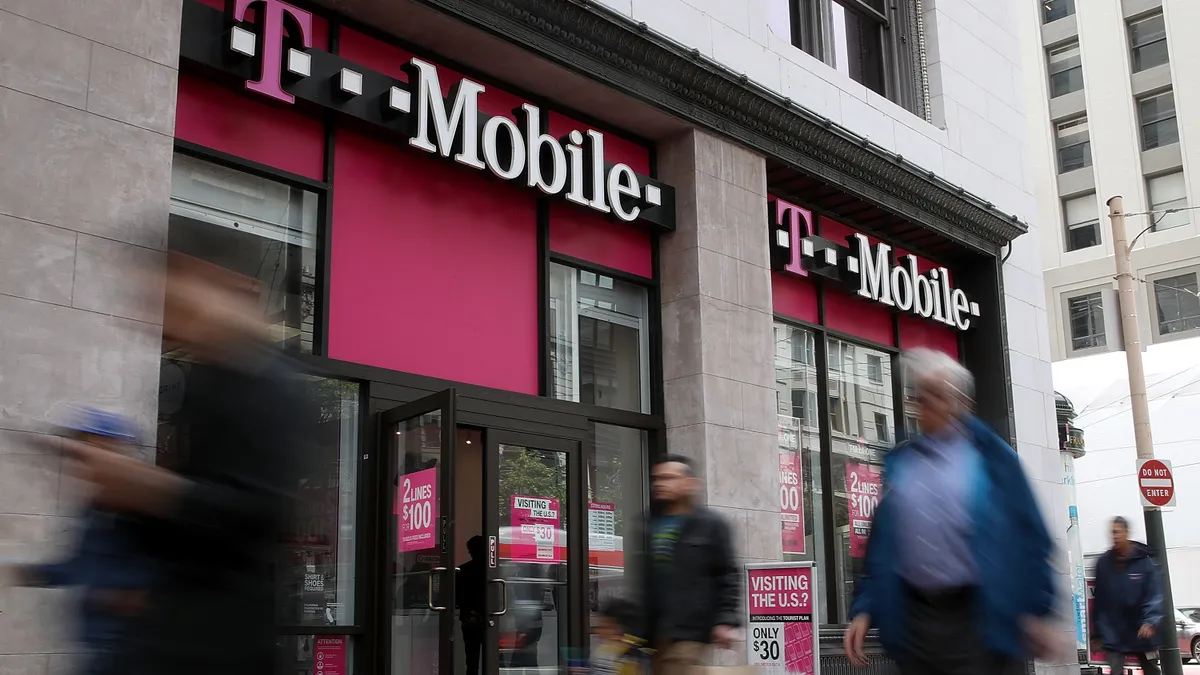
The company is also making progress opening more experience stores, with several hundred now open.
“Our experience stores see higher premium mix, higher NPS scores than our traditional outlets. And over time, our mix shift will lead to fewer doors, but also more meaningful customer experiences,” Gopalan said. “So even as our differentiation drives industry-leading growth, we continue to feed and stoke it so that the gap to competition only widens further.”
During a January earnings call, the wireless carrier reported a NPS of 79 at its company-owned stores, which is 16% higher than the NPS for third-party retail partners.