When tariffs rocked consumer confidence last spring, most U.S. consumers pulled back on their travel spending, opting for domestic, closer-to-home trips.
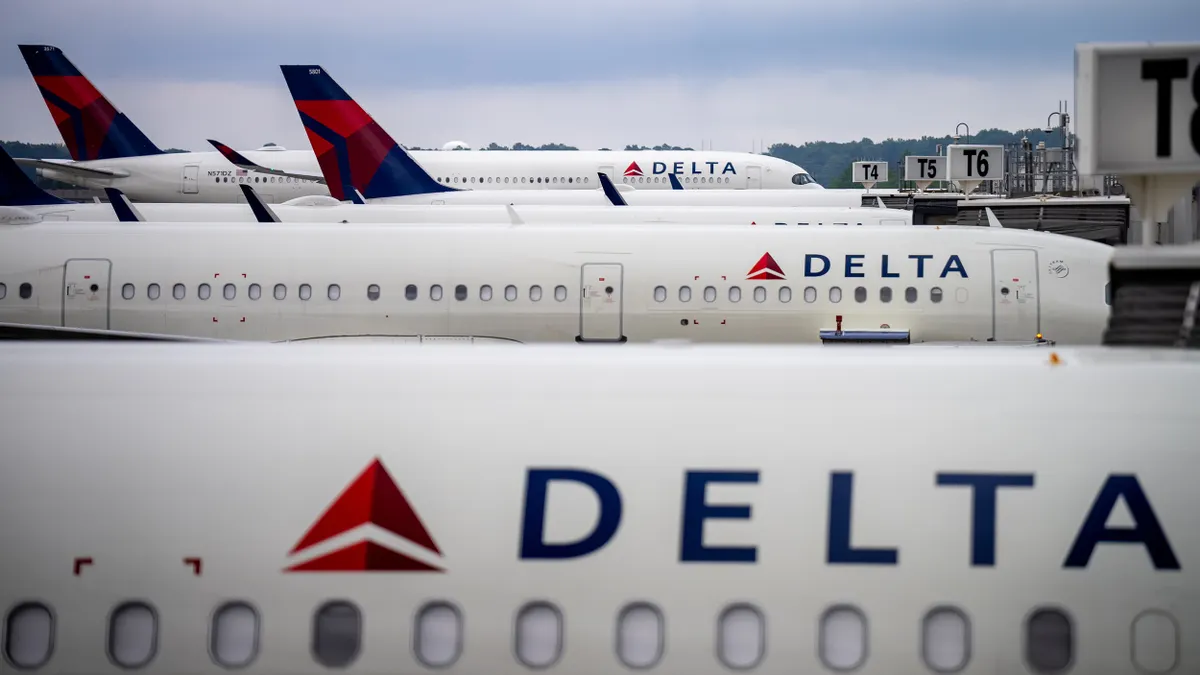
Airlines were prepared. On a Delta Air Lines earnings call just days after President Donald Trump announced sweeping levies that sent consumer sentiment plummeting, executives reassured investors. Premium experiences would provide resilience, even in a recessionary environment, the airline said.
“I don’t think we’ve ever had premium as a larger percent of our total revenues as we do right now,” Delta President Glen Hauenstein said on the April earnings call. “And so while parts of our business right now are challenged, and they’re mostly on the main cabin, lower end. We have not seen any cracks yet in the premium.”
Delta showed just how true that sentiment was in its first earnings report this year. Premium cabin revenue increased 7% year over year for the 2025 fiscal year, even as main cabin revenue decreased 5% year over year. Despite the difficult economic conditions, the company recorded record revenue of $58.3 billion for the full year.
Airlines are well known for charging more for premium services — whether for access to airport lounges or extra leg room. But other industries are taking a page out of airlines’ playbook as wealthy consumers continue to spend and the middle class pulls back.
Hotels, the telecommunication industry, and even healthcare providers are creating premium tiers, offering less hassle and more perks for consumers who want to pay for it. But whether this premiumization push is a good strategy is up for debate among experts.
The economy and consumer behavior
As some consumers pull back, others are spending. The top 10% of earners now account for nearly half of all consumer spending in the U.S., according to Moody’s Analytics. A Visa Business and Economic Insights analysis from November found about 12.2 million U.S. households make up the top 10% with an annual income of at least $210,000 or a net worth of at least $1.8 million.
Meanwhile, 91% of households are tightening their spend on discretionary categories to offset the mounting costs of essentials, according to a December EY-Parthenon US Consumer Sentiment Survey.
Premiumization “is actually a reasonable economic response to the bifurcated market we're seeing, the K-shaped economy, whatever we’re wanting to call it,” Isabelle Zdatny, head of thought leadership at Qualtrics XM Institute, said.
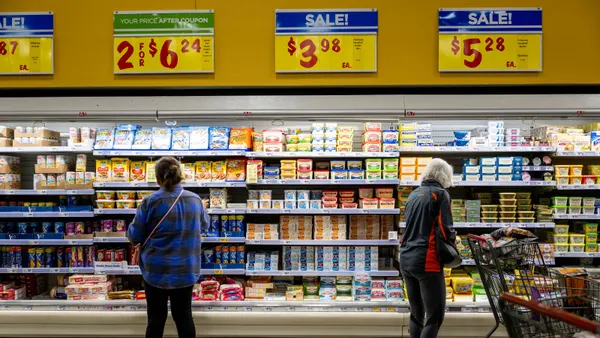
As lower-income Americans pull back, and even consumers making over $100,000 increasingly shop at Dollar Tree, consumers with more disposable wealth are paying up.
“They are not as price sensitive,” Kate Muhl, VP analyst at Gartner, said. “Compared to lower income consumers, they are more likely to say, ‘I always shop with brands I trust, I buy from favorite brands I consider myself loyal to.’ They'll over index for that, and they are more likely to experiment or explore new products or brands.”
In short, the wealthy are more optimistic about the possibilities of spending and buying.
“Economically, there's a story of inequality happening,” Muhl said. “It’s really about the bifurcation of consumers.”
While more households move to higher-income brackets and more wealth is concentrated at the top, more households are also joining lower-income brackets.
“It's the middle that's kind of hollowing out,” Muhl said. “So a lot of brands [are] faced with the choice of trying to go more premium and play to this growing group of people who have income growing or, consider aiming down to lower income groups who are going to struggle and where you're going to have to make the case for your value proposition.”
“For a lot of businesses, it's not a hard math to do — go where the money is,” Muhl said.
Other companies are essentially developing two businesses: one for the wealthy and one for the masses.
“In this type of K shaped economy, you don't always necessarily just have one business,” Zdatny said. “You could have two businesses at either end, and then make sure that you are delivering those experiences that align with your brand.”
And even as most middle and lower-income consumers are cutting back on discretionary spending, they are willing to splurge here and there for certain premium experiences.
Overall, customers are willing to pay more in discretionary sectors, like entertainment and leisure and travel and hotels, according to a December KPMG report.
In some cases, those businesses can use the profits from premium to reinvest in the overall customer experience, according to Steven Bailey, EY Americas Commercial Excellence Leader.
“It can be, from a business standpoint, a profit engine that can subsidize value elsewhere,” Bailey said. “You can turn affluent customers’ willingness to pay into a higher margin engine, and then that revenue can fund better baseline experiences when it's done right, [and] stabilize performance during times like now, when lower income segments pull back.”
Where premiumization can go wrong
Premiumization isn’t inherently bad.
“It’s very much aligned with an experience-focused strategy, where you’re embracing value-based pricing as opposed to just using a markup on production and delivery costs,” Jon Picoult, founder and principal of Watermark Consulting, told CX Dive in an email.
But experts agree that the success of premiumization depends on how it’s executed. Done well, it can inspire aspiration. Done poorly, it can ensure alienation.
“At the height of inflation, we talked about an effect called ‘skimpflation,’” Muhl said. “Skimpflation is basically, ‘We don't drive the price up, but we erode the quality of the thing. We want to bring our cost down.’ That kind of move to skimpflation is something consumers really hate.”
Some airline carriers are a case in point, as main cabin seats have shrunk, reaching a customer service representative quickly is a premium charge, and carriers have taken away complimentary food and beverage.
No-frills budget airline Frontier Airlines, for example, charges for Airport Agent Assistance, the ability to talk to a human customer service representative in the airport.
“The argument is, ‘We're actually opening up opportunities for people of less, lower means, or people who don't care about the ‘extras’ by giving them this kind of basic approach,’” Muhl said. “But, certainly, in the case of airlines, I'm not sure that people necessarily think that being able to pick your seat is a premium option.”
Frontier has also established a reputation for no frills, basic, cheap flights and made that its value proposition.
The question brands have to consider, Zdatny said, is are you providing a good baseline experience and offering an even better experience for a premium, or are you eroding the baseline experience to extract as much as you can from your customers?
“Where I think it gets alienating is the baseline experience that you're offering is bad,” Zdatny said. “So it becomes extractive, because people feel like they have to pay to get just any type of good service. It's the only way to get basic service, and that you end up signaling to those customers that they don't matter.”
The proliferation of companies using AI to cut customer service costs has exacerbated this issue, Zdatny said.
“As AI handles routine attractions, we see an increasing drive towards automation and efficiency,” Zdatny said. “Human attention becomes scarce, and then scarcity creates a value. So I think in some ways, we're actually watching human service become a luxury good in real time.”
Unless you’re a luxury brand, disregarding the interests of lower and middle-income buyers could spell trouble down the line, Picoult said.
“First, today’s middle-income buyers can be tomorrow’s mass affluent,” he said. “If you’re not leaving a reasonably good impression on that category today, what makes you think they’ll choose to do business with you in the future, when they have more disposable income? And, second, those lower and middle-income buyers can spread negative word-of-mouth just as effectively as more affluent customers.”
EY’s Bailey puts it another way: “If basic feels punished, it erodes loyalty.”
But done well, premium options can create aspiration and excitement.
“You've got to be explicit on what an upgrade or premiumization is buying, and so you've got to have that clear value proposition,” Bailey said. “It can't be just a nebulous aspiration or a nebulous better experience.”
Customers will pay more for control, according to Mark Levy, author of “The Psychology of CX 101.”
“Self-determination research consistently shows autonomy is a core psychological need,” Levy said in an email. “Premium customers value flexibility, discretion, and the ability to bypass friction. When people feel in control, the experience feels premium, even if it’s inexpensive to deliver.”
The key is giving customers a taste of premium, according to Bailey. Delta, for its part, is trying to give main cabin flyers a look at the front cabin.
“We’re hopeful again, we are going to go through this together, that those stay more resilient as we’ve offered more ways for people to get in the front cabin than ever, whether or not you use base fares and miles, whether or not you use miles themselves,” Hauenstein said on the April earnings call. “And the intent to repurchase is so high on those, we don’t see people downgrading even in a recessionary environment.”