
I've spent nearly 30 years in customer experience, and for most of that time the industry has operated on one basic assumption: people do the work, and technology helps them do it faster.
I built a business in that world, buying virtually every category of CX software along the way. I've seen firsthand how much better that technology made us. But I also watched the complexity accumulate.
We bought one system for calls, another for tickets, another for workforce management, quality, knowledge and analytics. Eventually, it became completely normal for a customer service organization to depend on nearly a dozen systems to resolve a single customer problem.
At the time, there was nothing irrational about that architecture. It worked extremely well for the era it was designed for. When people are doing the work, specialized software makes those people more productive.
Now, we must confront what happens when AI handles the work itself
The AI in CX conversation currently centers on whose agents are smartest, which model performs best and how much volume can be automated. Those questions matter, but if I were running a large customer operation today, I'd be looking underneath the agent at the very architecture they sit on.
Because the biggest difference between the last generation of customer service and the next may not be automation. It may be compounding.
Placing AI on top of the stack doesn't improve the stack itself. Instead, it detriments the AI — giving it all the same problems as before. If it can see the ticket but not the order history, it has a problem. If it understands why a customer is unhappy but can't take the action required to fix it, it has a problem. And if one AI handles the conversation while separate systems manage quality, knowledge and workforce planning, you've automated pieces of the operation without making the operation itself more intelligent.
And when the intelligence is fragmented, so is the learning.
We spent the SaaS era separating work into software categories. AI is going to force us to put the intelligence back together.
That matters because customer service has always struggled with the distance between recognizing a problem and actually fixing the system that caused it. A company can have thousands of customer conversations and still depend on people to connect the dots between a quality review, an analytics report, a knowledge update and an operational change.
AI gives us the opportunity to collapse that distance.
Imagine every conversation being evaluated, every failure traced to a cause, every proposed improvement tested before it reaches a customer and every approved change being a part of how the operation behaves going forward.
That is where compounding begins
A customer interaction is no longer just something to resolve and forget. It becomes information the operation can use to perform better the next time. Then that next interaction creates another signal. And another. The value isn't simply that AI does today's work faster. The system can become more capable because it did the work at all.
That changes the human role, too.
Calling it "human in the loop" is an undersell. As AI takes on more execution, people become responsible for governing the operation: establishing policy, making judgment calls, approving changes and deciding what the system needs to learn from the situations it failed to resolve.
It changes the scoreboard, too. We built many customer service metrics around the economics of human labor: average handle time, tickets closed, calls contained. Customers, of course, never cared about any of those things. They just wanted their problem solved.
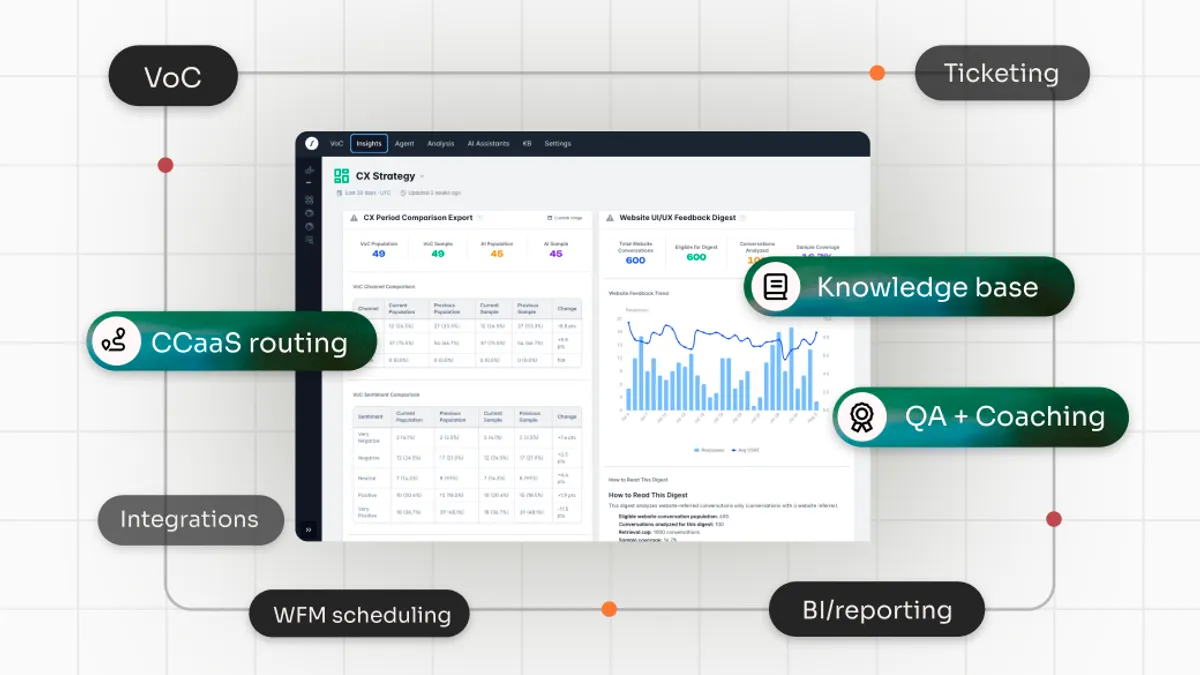
This is the conviction behind the platform we've built at Crescendo. Instead of putting another AI agent on top of the existing stack, we built customer conversations, quality, knowledge, workforce management, insights and optimization on one AI-native foundation. When something fails, the system can identify why, propose an improvement and test it before a person then approves the change.
The real value of AI isn't answering one more question. It's making the entire operation less likely to get the question wrong again.
Here is what I think most people are missing about this shift.
Imagine two customer operations adopt AI in the same quarter. One runs it on top of the stack it already had. The other runs it on a single foundation.
In month one, you might not be able to tell them apart. Same models. Similar accuracy. Similar resolution rates.
Then each operation gets something wrong.
In the first, a bad answer gets caught in a QA sample. Someone writes a coaching note. Someone else may eventually update a knowledge article. Another team may change a workflow. The fix stays wherever someone happened to make it.
In the second, that failure is scored, traced to whether the cause was a policy, a knowledge gap, a routing rule or a broken integration, corrected once and the correction reaches everything downstream of it.
One operation improves in pieces. The other compounds
The difference may look small in one month. By month 12, these are no longer the same businesses.
One has spent a year getting incrementally more efficient at a fixed level of quality. The other has spent a year building a record of every way its customers get confused and every fix that worked — which is an asset no vendor can sell and no competitor can copy, because it's built on unique customer interactions.
That is the compounding advantage of AI-native customer experience. And time matters
Efficiency gains can be purchased later. Compounding can't. Just like investing, you can always increase the deposit but you can't buy back the years.
For decades, growing a customer operation meant adding some combination of people and software and getting better at coordinating the two. AI gives us the chance to rethink that model for the first time.
The companies that understand this won't spend the next decade asking how many AI agents they can deploy. They'll ask the harder question: If every customer interaction can make the next one better, why are we still running customer experience on systems that were never designed to learn together?