Amazon is bullish on the power of first-party agentic AI, but the company isn’t discounting the potential third-party platforms hold.
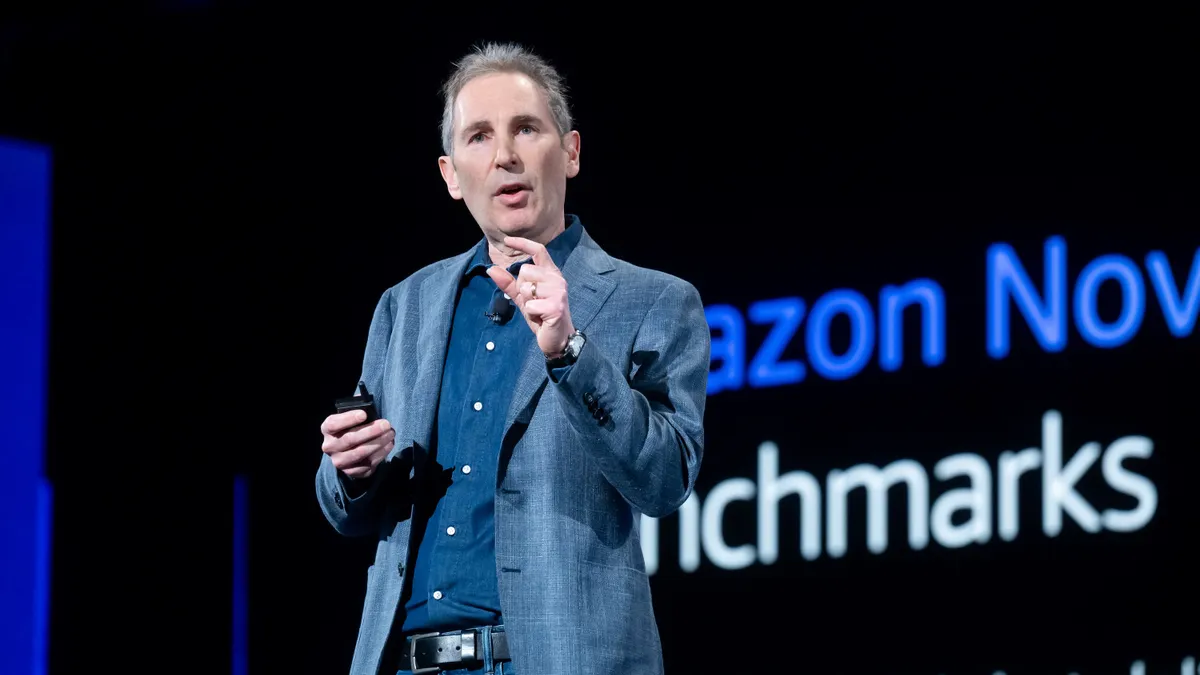
“As I've shared a lot of times, I passionately believe that every customer experience that we know of today is going to be reinvented with AI,” Amazon president and CEO Andy Jassy said during a Q4 2025 earnings call Thursday. “There are going to be a whole bunch of customer experiences that none of us ever imagined that are going to become the norms of how we all operate every day.”
For its part, Amazon saw 300 million customers use its AI shopping agent, Rufus, last year, according to Jassy. Customers who used Rufus were about 60% more likely to complete their purchase.
As the experience becomes more mainstream, many customers will choose to use first-party AI shopping agents over third-party “horizontal” agents, Jassy said.
Customers are looking for a broad selection, low prices, fast delivery and a retailer they can trust to take care of them, Jassy said during the call. “And I think horizontal agents are pretty good at aggregating selection, but retailers are much better at doing all four of those items.”
Shoppers who begin testing shopping tools are likely to prioritize first-party agents, especially from retailers they trust, according to Greg Carlucci, senior director analyst at Gartner. Nearly two-thirds of consumers say buying from brands they trust is more important now than it was five years ago, according to a 2025 survey from the analyst firm.
Data is another advantage retailers hold over third parties, according to Jassy. Retailers already have all of their customers’ shopping history, which makes it easy for shoppers to pinpoint an item and shop for it immediately, compared to third-party agents serving as the middlemen between the retailer and the consumer.
Data concerns also play a role in consumers’ likelihood to adopt retailers’ first-party AI solutions, according to Carlucci.
“This preference for trust is driven by several factors: confidence in data privacy, personalized experiences, and direct accountability for service quality,” Carlucci said in an email. “Retailers’ own agents can leverage proprietary customer data and loyalty programs to deliver tailored recommendations and seamless support, which resonates with consumers seeking reliability and familiarity.”
Jassy says Amazon will still likely have relationships with third-party agents, but he believes retailers and AI companies still need to collectively improve the customer experience.
“These horizontal agents don't have any of your shopping history,” Jassy said. “They get a lot of the product details wrong, they get a lot of the pricing wrong. And so we have to try to find a customer experience together that's better and a value exchange that makes sense for both parties.”
Amazon is open to third-party partnerships, but it is wary of shopping agents that don’t meet with the company on its own terms. The retailer filed suit against Perplexity in November, alleging that the company’s Comet AI agents accessed the Amazon website in a covert manner.
Other experts have warned that data could be a point of contention for third-party agentic AI. These tools need data from their merchant partners to operate properly, and they could potentially charge companies for what they learned from customer journeys made using their AI in the future.
Near term agentic shopping adoption will be slow in general, according to Carlucci.
Just over half of millennials — 56% — said they will be willing to let AI handle or assist them in some of their shopping tasks, according to Gartner’s survey. And while 55% of high-income consumers are willing to let AI assist with shopping tasks, that share drops to 33% among low-income consumers.