Dive Brief:
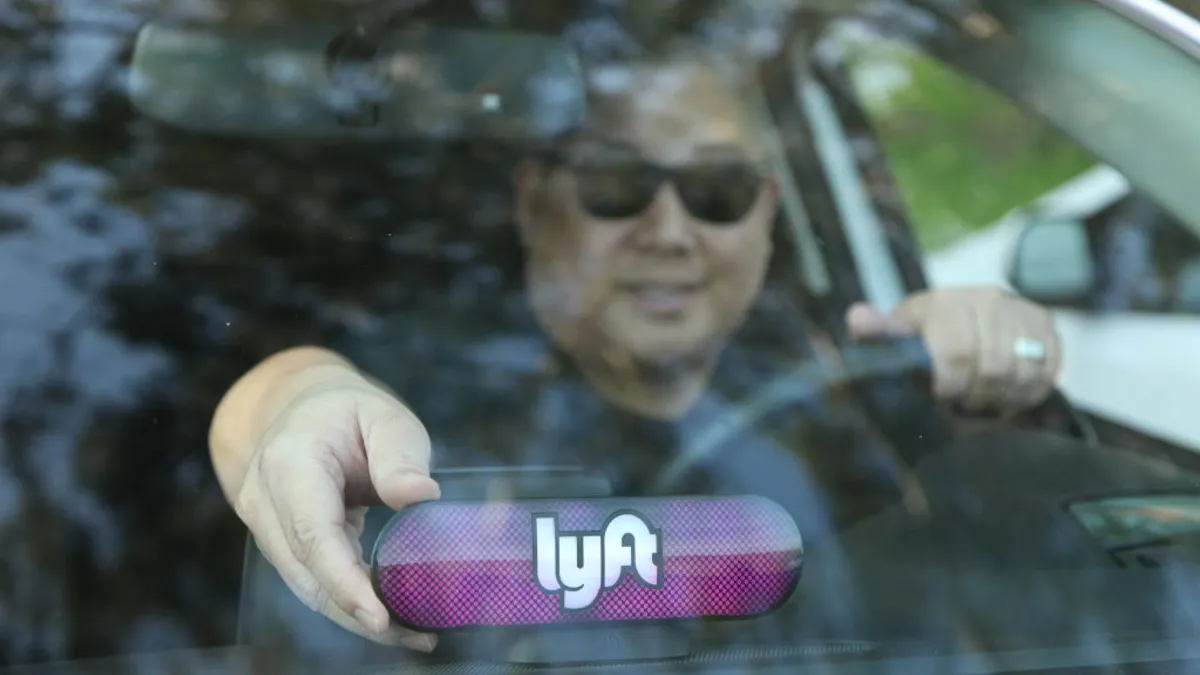
- Lyft CEO David Risher credited the company’s most profitable quarter ever — over $1.1 billion in cash flow — to customer obsession. “Customer obsession is what drives our profitable growth,” Risher said on a Q4 2025 earnings call Tuesday. “I think I feel more strongly about that than ever.”
- Revenue grew 3% year over year to $1.6 billion in the quarter and 9% year over year to $6.3 billion for the full fiscal year, according to an earnings report.
- The company saw engagement and retention grow, too. Gross bookings grew 19% year over year to $5.1 billion during the quarter, active riders grew 18% year over year, and the company retained a record number of riders in the quarter.
Dive Insight:
Lyft doesn’t see itself as competing with other ride-hailing companies; it sees itself as courting all potential riders.
While Lyft does around 1 billion rides and its competition does in total roughly 3 billion or 4 billion, that only makes up about 5 billion out of 100 billion total rides in the market, Risher said.
“That's 5% penetrated, which shows there is an enormous amount of headroom in this market,” Risher said. “So what does that lead you to do? What it leads you to do is to focus on your customers, not your competitors, because if you focus on your competitors, you're just fighting over the 5%, not the 95%.”
Risher also credited its alliances with companies like DoorDash, which he called “our most successful partnership ever,” for the market penetration the company has already achieved.
“We have millions of people who are now kind of cross-linked on the platforms, and there's still a huge, huge headroom there,” Risher said.
Since rolling out its partnership with United Airlines in November, Lyft customers have earned over 115 million United MileagePlus miles on the Lyft platform, according to Risher.
The partnership is especially strong in markets like San Francisco, where the airline operates a major hub and customers are eager to rack up MileagePlus miles, according to Lyft CFO Erin Brewer.
The company is looking at expanding its partnerships, as riders that come through partnerships “tend to take a higher mix of higher-value rides,” according to Brewer.
Asked about future developments to its loyalty program, Risher was light on details but provided investors with the company’s approach to loyalty.
“The best way to create a loyal customer, loyal rider or driver, is to do well by them,” Risher said. “I mean that's just the flat up best way. Everything else is a little bit on top of that.”
To build on the record number of retained riders in the quarter, the business is starting to build programming that specifically speaks to different customer segment needs.
“If you look at business travelers, there's a very well-understood dynamic that involves getting typically points, cash back or something on business travel and then spending them on leisure,” Risher said. “And we now have a great program there. It's up activations, as we mentioned in the prepared remarks, up 26% year on year.”
On the consumer side, Lyft rolled out the Lyft Cash Rewards program in October, which requires riders to put $25, $50 or $100 in accounts to receive a certain percent cash back.