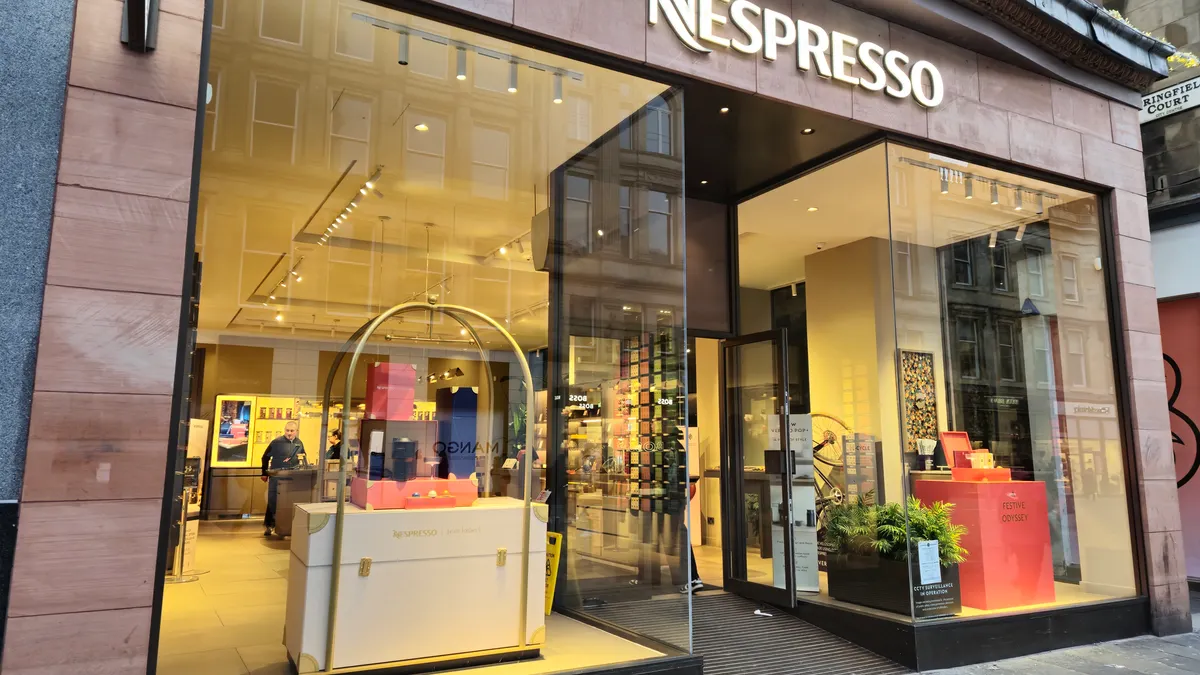
When Nespresso brought its Nespresso Club loyalty program to the U.S. this summer, it wasn’t starting from scratch. It was bringing a dormant program back to life.
The original Nespresso Club is a program from a very different time and place, according to Jean-Christophe Jaunin, CEO of Nespresso North America at Nestlé SA. The goal then was to create an intimate community of coffee lovers who could connect through the brand’s retail locations.
“It was a time when espresso was much smaller, and there was a bit of a notion of exclusivity,” Jaunin told CX Dive. “If you had the espresso machine at home, you were part of a kind of a special group of people, and that was the club.”
That program helped Nespresso build its brand in the early 2000s, but over time, the customer base outgrew that original vision, according to Jaunin. Espresso drinkers were no longer an exclusive club, which made that version less relevant to Nespresso’s audience.
Today, the espresso community isn’t a small one — just the opposite — and the Nespresso Club is the backbone of the coffee company’s customer relationships. The revived program emphasises personalized rewards over points and aims to build relationships with customers, with perks for members at all spending levels.
Personalization and community over points
Nespresso Club doesn’t offer traditional points. While the program has transactional benefits and typical rewards like birthday and anniversary gifts, the perks aim to reward customers’ preferred behavior and build communities among likeminded fans.
“There's always going to be a transactional part, obviously, but it has to go way, way above that,” Jaunin said. “Otherwise, it's just a matter of points, and we don't want to be another airline points catalog of things and stuff. We really want to focus on behaviors, engagement.”
Instead, Nespresso Club’s major draw is access to exclusive coffee blends and personalized discounts based on customer behavior, according to Jaunin. When a customer tries out a limited edition flavor or takes part in a class with a barista, the company has a better idea of the kinds of rewards that matter.
“Naturally, it's a reward, but it's one that actually brings me into a group of people that have the same interest, the same passion for creating that seasonal recipe,” Jaunin said.
These personalized offers are designed to help Nespresso recapture some of the community feel of the original program, according to Jaunin. The goal is to make customers feel like they’re part of a like-minded community that values the same perks as them, not just choosing from a generic menu of discounts.
The community-focused approach to loyalty works best when brands help customers with something they already care about, according to Patricia Camden, EY Studio+ U.S. marketing, customer experience and loyalty leader at EY.
“That changes the role of the loyalty program,” Camden said in an email. “The brand is no longer only rewarding transactions, but creating access, recognition and participation.”
Better customer connections through loyalty
The North American version of Nespresso Club wants to have a strong menu of rewards for customers that fit their needs, with an emphasis on connections and community.
“We will make sure that there is something that fits your purpose,” Jaunin said. “We are in early days, so we're still building the options and the experiences that we want to provide. But the idea is that there should be something for everybody.”
Nespresso’s emphasis on customer relationships and communities will help it with this process, according to Jaunin.
“When we didn't have the club, there was a lot of story going on between the customers and Nespresso,” Jaunin said. “But maybe it sometimes felt a little bit random, like I was rewarded for something, and I was not necessarily sure why. Today there is clarity. We're building a story between the customer and us, and we're trying to do it in a more personalized way.”
It makes sense for a brand to relaunch a loyalty program when it identifies a clear opportunity, as opposed to following its competition, according to Camden.
“The right time is when the company has a clear customer problem to solve, a proposition people will value and the operating/organizational commitment to sustain and evolve the program,” Camden said. “If the rationale is simply that competitors have a program or an old member data file is sitting unused, the company is not ready.”
A well-run loyalty program can also be a great source of customer insight that goes beyond raw data, according to Camden. When a loyalty program is focused on customer relationships, it creates opportunities for better decision-making.
“A brand can see which customers are becoming less active, address a service problem before it turns into churn, test which benefits actually change behavior and give customers reasons to identify themselves across channels,” Camden said. “It also gives the customer a way to express preferences rather than leaving the brand to infer everything from transactions.”
Offering fitting rewards for all members
Nespresso is still working on designing its full spread of loyalty rewards, but the foundational approach of offering something for everyone is already in place.
“You're part of this big community, but we know you are different,” Jaunin said. “You are special as a customer, and we can actually start to talk to you in a specific way and reward you based on who you are, and not just because you transact with us.”
Details like whether a customer has visited a Nespresso boutique store, whether they recycle their capsules, and other forms of engagement offer the company opportunities to recognize and celebrate relations based on how the customer interacts with the brand, according to Jaunin.
Nespresso’s international partners are key to the revived Nespresso Club as well, Jaunin said. One example is when the company invited several of its VIP rewards members in Europe to a red carpet experience at the Cannes Film Festival.
“All of those partnerships open doors to what we like to call ‘the money can’t buy experience,’” Jaunin said. “We can bring you to places or to events that, even with all the money in the world, you could not access.”
Even outside the biggest rewards, there are differences between members. In the U.S. program, customers who sign up for a subscription or purchase at least 800 coffee capsules in a single year receive Ambassador status. The benefits of this higher tier include invitations to special events and special gifts.
Large rewards can be appealing, but the key is keeping the core program worthwhile for everyone, according to Camden. Higher-value customers can earn recognition, convenience or access, but the public differences should feel earned and achievable for all loyalty members.
And while super exclusive perks are nice for top-end VIPs, brands don’t have to break the bank to please the average loyalty member.
“In our research and work, we have found that generally, the best perks are often benefits that remove friction rather than expensive gifts,” Camden said. “As an example, with a specialty retailer, early product access and easier returns mattered because they made customers feel known, but the basic experience stayed useful for everybody.”
Nespresso is working to ensure there are options for every member, according to Jaunin. Not everyone will earn a visit to Cannes, but rewards like free recipe demonstrations fits the brand’s wide approach. The goal is to offer a wide variety of experiences that let customers interact with the brand however they see fit.
“By interacting in this way or that way, online or offline, you'll get some personalized rewards down the line,” Jaunin said. “I think that's a really exciting journey for a brand like us.”