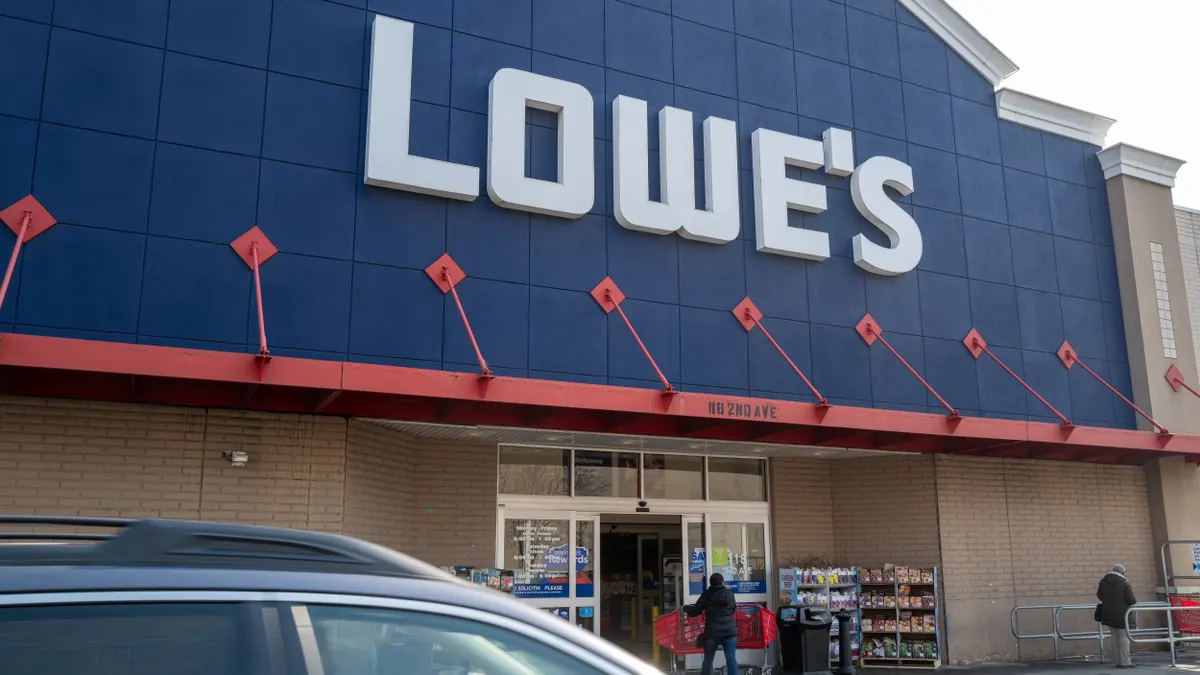
Since Lowe’s launched its AI-powered assistant, Mylow, nearly a year ago, the company has watched and learned from customers using the tool.
Lowe’s has observed, for instance, a shift in how customers go about researching products and projects, according to SVP of Digital Commerce Joseph Cano. Customers are typing in conversations, rather than specific keywords.
“Search used to be three or four keywords you tried to really hone in on,” Cano told CX Dive. “Now, people are actually doing full sentences like, ‘How do I start my kitchen renovation project?’”
Lowe’s is taking what it’s learned and applying those lessons across its customer experience, from bridging the gap between in-store and online experiences to improving personalization. The home improvement retailer’s goal is to build trust with customers as agentic shopping grows.
“We're trying to create a very easy ecosystem so that no matter what you want to do, we've got you covered, whether it's just a product or it's a project,” Cano said.
Connecting online and in-store experiences
While many customer journeys start online, the lion’s share of Lowe’s business is still done in-store, according to Cano. The company is using AI to bridge the gap between the digital and physical parts of the experience.
When customers start planning a project through Mylow, they can save that information in their profile. In the store, associates can pull up that profile and let the customer go around seeing and feeling every piece to make sure the product fits their needs.
Profiles also help Lowe’s keep in touch beyond that initial visit. Associates can offer to follow up, and if the customer agrees they can reach back out in the following weeks about updates to the project.
“They can reach back out to you and say, ‘Hey, I see that you actually changed your tile. We've got that [in] stock if you want me to place that order for you,’” Cano said. “That is a great way for us to connect.”
AI is helping Lowe’s improve its in-store experience by improving associate knowledge as well, according to Cano. The retailer’s Mylow Companion app lets workers use voice or text to ask questions about items in store, which improves their ability to assist customers.
“If I am not the resident expert in, let’s say, plumbing or electrical, but somebody comes with the question, I can ask our own agent, ‘Hey, what part do they actually need?’” Cano said. “It will direct me into the right aisle.”
Better personalization through AI
Lowe’s customer experience goes beyond products to encompass more than 4,000 content articles about home improvement topics designed to help customers get projects started.
Customers are reaching these articles through Lowe’s AI tools and search as they seek out help for their problems, according to Cano. The articles are presented as a helpful start to the customer journey.
“Most homeowners don't know how to take care of their homes,” Cano said. “A lot of the time we see, ‘How often do I change my air filters? How often do I change my filter on my refrigerator?’”
Lowe’s is refining its algorithms to help improve personalization, according to Cano. The company knows what a customer has searched for in the past, and when a customer searches with a full sentence, the AI can offer to turn the query into a conversation.
“We take all those little key ingresses that we've seen as you're shopping throughout Lowe’s,” Cano said. “So if we see you shopping for vanities, we're going to say, ‘Hey, do you need to renovate your bathroom?’”
Trust is key to embracing AI experiences
Trust is paramount as agentic shopping enters the mainstream.
While consumers are embracing AI-powered search due to its ability to speed up shopping journeys, giving AI agency to act on their behalf and buy items for them is a different matter, according to Jon Copestake, global senior consumer analyst at EY. He sees consumer adoption growing slowly until trust is built.
Lowe’s sees building that trust as one of the key goals in its AI strategy for both internal tools like Mylow and sharing information with third-party agents.
“We're trying to instill in our customers that you can utilize Mylow, and it can be trusted,” Cano said. “You can utilize other agents as well, because we are giving them the information directly.”
Lowe’s AI efforts go beyond its in-house tools to ensure customers accessing its information through third-party agentic AI have a dependable experience.
“No matter where a customer is searching, we want to make sure that we show up in the right way,” Cano said.
Lowe’s is making its sites “very crawlable” by AI agents to ensure they return the right information to potential customers, Cano said. The process involves designing separate journeys for AI and for humans.
“We're creating parallel paths to ensure that this is just another shopping journey for us,” Cano said. “We want to make sure that we are available, and we're getting the right information out there.”
Each agent functions a bit differently, and Lowe’s is constantly working to ensure they can each understand the data on its site, according to Cano. He sees an agent-friendly site as something that will be paramount for Lowe’s success as agentic shopping enters the mainstream.
“While it is still small relative to the Google search algorithm, it is still something that is important, and it's growing very rapidly,” Cano said.