Dive Brief:
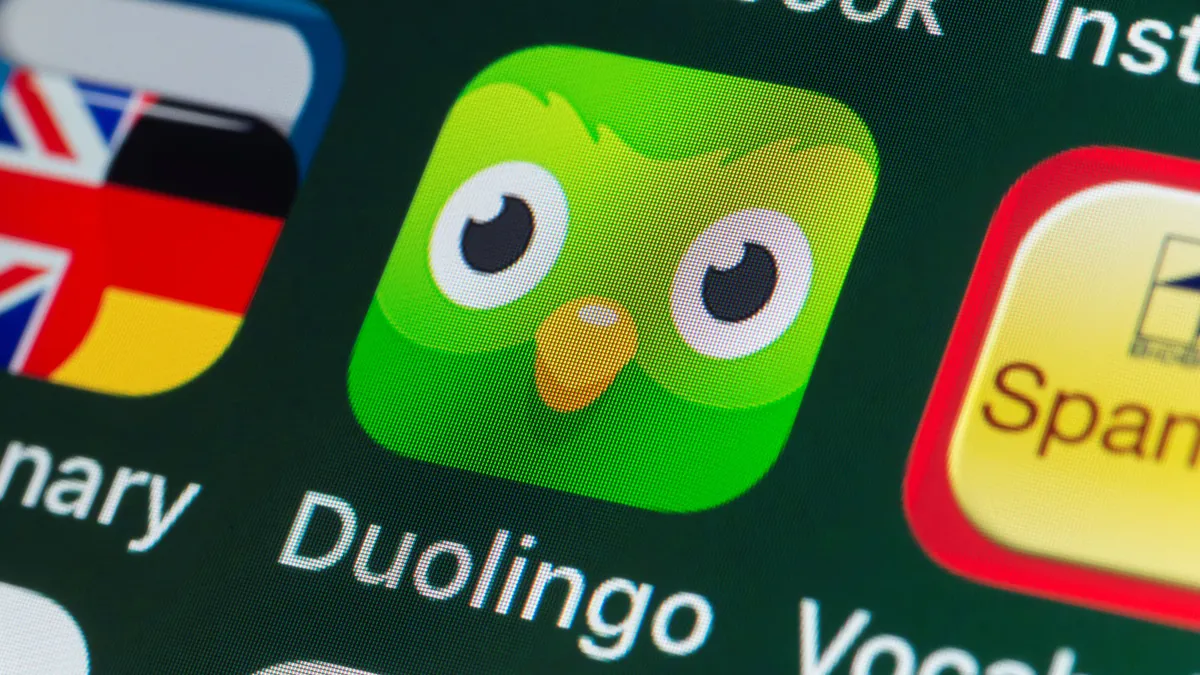
- Duolingo improved the free user experience to drive word of mouth referrals and retention, Luis von Ahn, co-founder and CEO of Duolingo, said on a Q1 2026 earnings call Monday.
- The language learning company has added “spoken tokens” to encourage speaking exercises, flashcards to build fast recall, and “speaking adventures” featuring real-world scenarios to both the free and paid subscriptions.
- Daily active users grew 21% year over year in the quarter to 56.5 million, and paid subscribers grew 21% year over year to 12.5 million, according to a letter to shareholders.
Dive Insight:
Duolingo views 2026 as a key strategic investment year for the company as it focuses on increasing daily active user growth by improving the free user experience.
Duolingo’s revenue grew 27% year over year to $292 million, and the company reported net income of $43.5 million, according to the earnings release.
“Word of mouth has historically been the main growth driver for us,” von Ahn said. “Most of our users come to Duolingo through word of mouth.”
In the past two months, the company improved its unpaid tier, making more features available to free users and improving the product’s teaching capabilities, which “should accelerate word of mouth” and improve stickiness, he said.
“Word of mouth is this interesting thing that is beautiful because it's free, but we don't have that much control over it in terms of being able to measure it the same way that we can measure retention,” von Ahn said. “So we're doing things that we think are going to be really good for word-of-mouth, but we don't have the granularity of control that we have for things like retention.”
The language learning app had previously “overdid” its monetization tactics in the free user experience, which added too much friction and were at odds with daily active user growth, von Ahn said.
The company is still finding ways to monetize, however, and wants to drive more users into paying subscribers. About 12% of monthly active users are paying subscribers, which is below the comps of other freemium models, von Ahn said.
“What we need to do and what we are doing, which I'm very excited about, is finding ways to monetize that don't put [daily active user] growth at odds with monetization,” he said.
Among those efforts is extending the free trial period for the paid subscription options.
“Historically, Duolingo has given a 7-day free trial, and that has worked well for us,” he said. “We're finding that giving longer free trials is really good in that not only does it give us more bookings — that's good — but also, it's good for the user. They feel good.”
The company is heavily leaning into AI to build learning content and personalize exercise selection. In the first quarter, it published 20,500 course units, which is more than 10 times what it published in a quarter two years ago.
“We've always had a model that picks what exercise to give to each user, but we're working on significantly more personalization,” von Ahn said. “Because that's exactly what a one-on-one human tutor does.”
“We may even start generating content just for you,” he said. “Based on everything that we know about you, we may just be able to generate content just for you.”