Dive Brief:
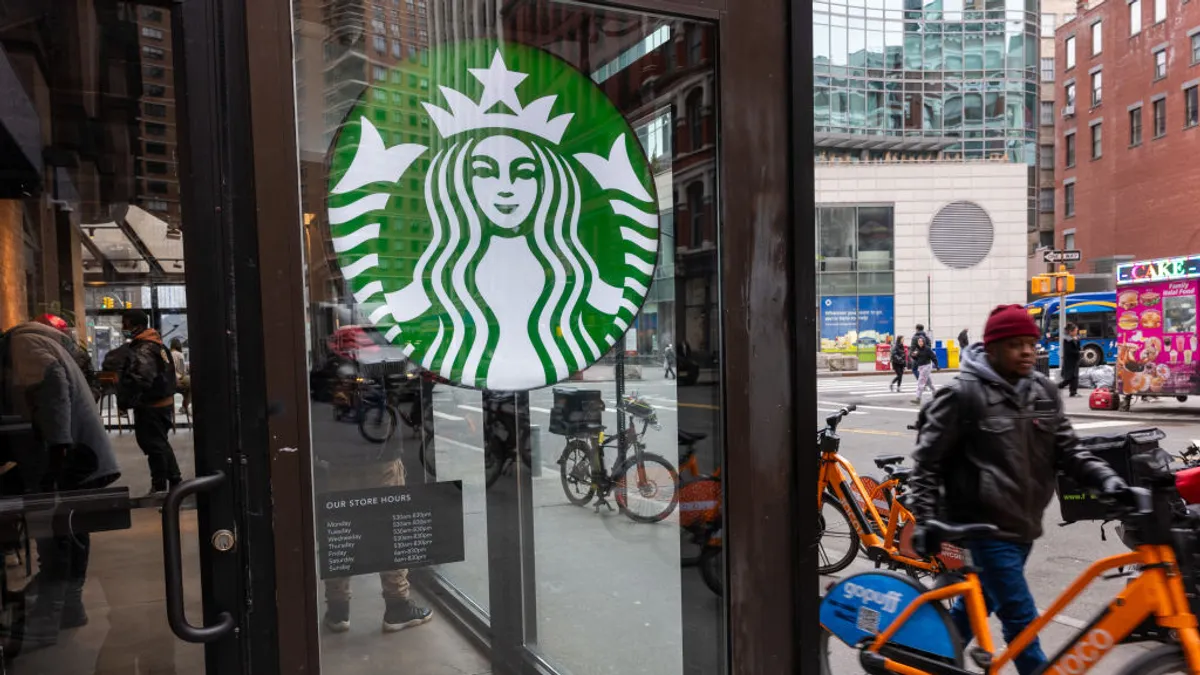
- Starbucks has launched a beta app in ChatGPT that lets customers start their order on the AI platform and finish it in the Starbucks ecosystem, the company announced Wednesday.
- Customers can enter prompts, using either words or a photo, to help discover new drinks that fit their "vibe," the company said. Prompts can include details such as time of day, weather, the customer’s mood, or a specific kind of flavor.
- From there, ChatGPT will suggest a drink and let the user select a Starbucks location they’d like to order from. Customers can then customize their order, and finish the checkout process in the Starbucks app or on Starbucks.com.
Dive Insight:
The launch of a Starbucks app in ChatGPT is part of the cafe chain’s broader effort to expand discoverability. Or as Starbucks puts it, it wants to capture customers' "vibe."
The ChatGPT experience aims to help customers discover new drinks based on attributes other than names. Example prompts include “@Starbucks, I want something bright to start my morning,” and “@Starbucks, I’m craving an afternoon boost that isn’t too sweet.”
The ChatGPT experience builds on discovery-focused additions to the Starbucks app, including a trending beverage category and a secret menu for Starbucks Rewards members.
OpenAI has been rethinking Instant Checkout, a feature that lets shoppers buy from third-party companies without leaving the ChatGPT environment. Last month, the AI company said that the option “did not offer the level of flexibility that we aspire to provide.”
Walmart, which was an early Instant Checkout partner, has now launched a new experience that lets customers discover items in ChatGPT and takes them to a Walmart environment that supports account linking, loyalty and payment.
Other companies are looking at third-party AI for product discovery while keeping the checkout process in their own ecosystems.
In February, Williams-Sonoma began testing ads in an OpenAI pilot program with the goal of exploring ways to reach customers as they make purchasing decisions. Target is participating in the program as well.
While consumers may be open to using AI for initial product discovery, some research has found they lack confidence in the technology’s suggestions.
Even though 2 in 5 consumers have used AI to research products, only about one-quarter of consumers trust AI-powered recommendations outright, according to a January survey from the IBM Institute for Business Value and the National Retail Federation.