For all of the talk of AI, retailers are well aware of the role their associates play in crafting their in-store experience.
On earnings calls last week and in recent announcements, major companies from Target to Walmart, are touting their investments in their human workforce.
While AI works as an accelerator that helps customers work through complex but low-impact decision-making, consumers still look to other people when they feel they truly need help, according to Greg Carlucci, senior director analyst at Gartner.
“What's interesting is that we have seen that consumers are more inclined to speak with store associates if they are more sensitive or for high-importance decision making,” Carlucci told CX Dive. “I think people inherently have also just grown up with store associates, and asking them questions to get a second opinion is still immensely valuable.”
Retailers aren’t pursuing any one strategy. While Lowe’s and ACE Hardware are equipping workers with their own AI tools to improve their ability to help customers, Walmart and The Home Depot are upskilling employees to enhance their knowledge. Others, like Target, are simply investing in payroll and operations to ensure more support is available on the floor.
AI works just as well in the hands of the associate
AI assistants aren’t just for supporting consumers. Retailers are reporting success when they offer associates their own specialized tools.
Use of Lowe’s Mylow Companion, its AI assistant designed for associates, is driving a 2% increase in in-store customer satisfaction scores, according to President and CEO Marvin Ellison on an earnings call last week.
ACE Hardware launched the Hey ARMA assistant at over 2,300 stores last month, where it is expected to work in the background helping associates support shoppers.
AI assistants are well-suited for helping associates dig for small but important details, according to Carlucci. Well-trained employees already offer great advice, but AI can still help them by finding exact numerical details about a product’s dimensions, size or functionality — greatly speeding up service when customers need a very specific item.
“Historically, if you had asked a question to a store associate, they may have had to reach out to a manager or go to the help desk,” Carlucci said. “A portable AI device can answer or help answer those questions, and it can also make sure they're giving out the right information.”
Specialized training and roles support decision-making
With AI well suited for supporting customers on general shopping journeys, some retailers are investing in specialized roles to ensure their employees can help customers when it really counts.
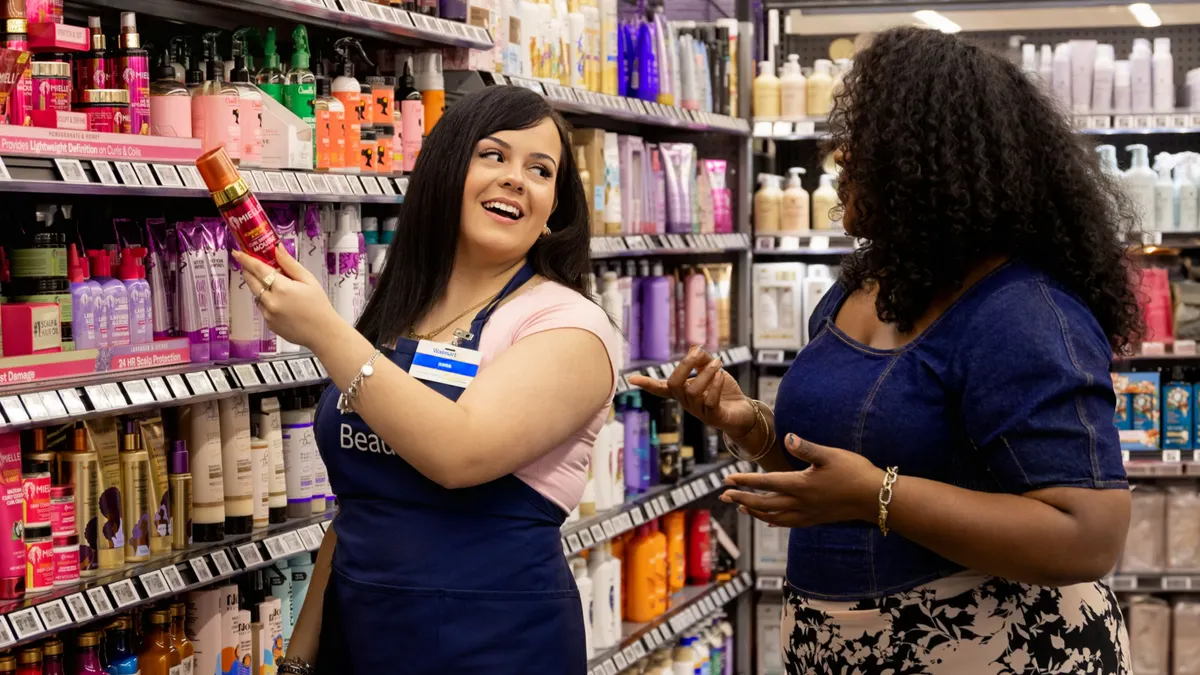
Walmart, for example, is introducing the “Beauty Expert” position at hundreds of stores this year following a successful pilot. These workers receive initial training that goes beyond standard onboarding and follow it up with ongoing monthly and quarterly training. The retailer also provides them with “Walmart Beauty Boxes” so they can test different products to offer customers more informed opinions.
Investing more in associates who work in the higher-stakes categories at the big box stores makes sense, according to Carlucci. A dedicated beauty expert can answer complicated questions about skin care or product’s effects that are beyond an AI’s capabilities.
Another retailer introducing more specialized roles is The Home Depot, which began testing separate merchandising and in-store customer service teams late last year.
Stores that made the change are reporting an improved likelihood for visitors to shop again and greater customer engagement, according to Ann-Marie Campbell, senior executive vice president of U.S. stores and operations at Home Depot. On an earnings call last week, Campbell shared the retailer’s plans to roll out the operational changes across all its stores by the end of the year.
Dedicated support roles make sense for retailers that are selling expensive items with high price points like large scale appliances, according to Carlucci. It’s not necessarily about expertise — the reassurance of white glove service can be just as important.
“Having specialized store employees, I think, does help reinforce the fact that you're receiving not just paying for the product itself, but you're also getting that additional support and hand holding to make sure you're making the right decision,” Carlucci said.
Adding associate hours improves the experience
It’s not just flashy technology or special training that moves the needle for customers. Simply ensuring that stores have enough staff on hand can have a significant impact on the experience.
Target achieved three-year highs for its net promoter scores and customer satisfaction in its stores, according to EVP and COO Lisa Roath on an earnings call last week. The improvements were attributed to investments in its store experience and labor hours announced earlier this year.
CX and satisfaction metrics were higher in stores that received increased training and labor support, according to Roath. The retailer also rebalanced workloads to let employees spend more time helping customers, and it is planning to simplify its fulfillment processes to enable fast, store-based delivery without compromising the in-store shopping experience employees provide.
Putting money toward human support, rather than focusing on technology, can pay off for the company, according to Carlucci.
“I think that enhances Target. For example, employees have more dedicated time to answer more specific questions,” Carlucci said. “I think consumers also still want another human perspective, instead of just AI.”