Dive Brief:
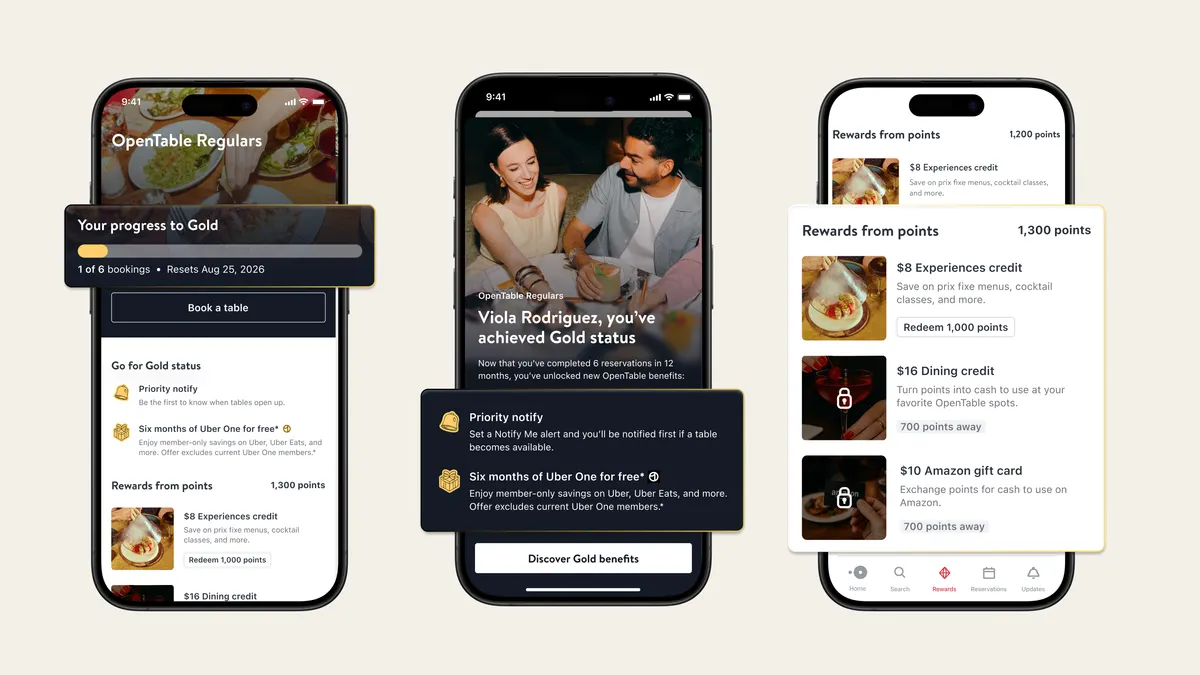
- OpenTable has introduced a new benefit to its OpenTable Regulars loyalty program that offers frequent users first access to reservations at popular restaurants, the company announced Wednesday.
- Members who achieve gold status, which is earned by honoring at least six OpenTable reservations within 12 months, receive access to “primetime reservations” at more than 500 hard-to-book restaurants in 50 cities.
- Gold members also receive alerts for last-minute restaurant openings from OpenTable’s Notify Me feature before other customers and are eligible for six free months of Uber One membership.
Dive Insight:
Experiential benefits can help loyalty programs like OpenTable’s move beyond transactional benefits to create true emotional connections with customers.
Any restaurant can offer discounts or free menu items, making them easily replicable by competitors, according to Ryan Volberg, founder and CEO of guest recognition platform Guestologie. However, status and access are the strongest loyalty drivers.
“Giving a guest the ability to secure an otherwise impossible reservation is therefore far more meaningful than offering another free appetizer or discount,” Volberg said in an email. “It makes the guest feel recognized, valued and part of something exclusive.”
OpenTable research found that customers respond best to rewards that are easy to understand, easy to use and genuinely valuable, John Tsou, SVP of Growth at OpenTable said in an email. “Gold Tables delivers on all three by turning loyalty into access.”
Other experts note that loyalty program members are looking for a combination of simplicity, speed and relevance in rewards. Experiential benefits pair well with transactional rewards, and OpenTable Regulars already lets members earn and redeem points for rewards like credit toward reservations.
Exclusive reservations are just one option for restaurants looking at adding experiential rewards, according to Volberg. Perks like exclusive events, behind-the-scenes experiences and personalized recognition can all further deepen customer relationships.
“The irony is that many loyalty programs invest heavily in earning points after the visit, while the moments that most influence loyalty occur during the visit itself,” Volberg said. “A guest is far more likely to remember being genuinely recognized, welcomed by name and treated in a way that reflects their relationship with the restaurant than they are to remember earning another 200 points.”
The challenge is that experiential benefits can be difficult to commoditize due to being rooted in hospitality instead of economics, according to Volberg.
“They strengthen emotional loyalty, deepen relationships and give guests a compelling reason to choose one restaurant over another, even when the food, price and location are comparable,” Volberg said. “In the long run, experiences create advocates, while discounts often create shoppers.”
Editor's Note: This story has been updated to attribute OpenTable's comment to John Tsou, the company's SVP of Growth.