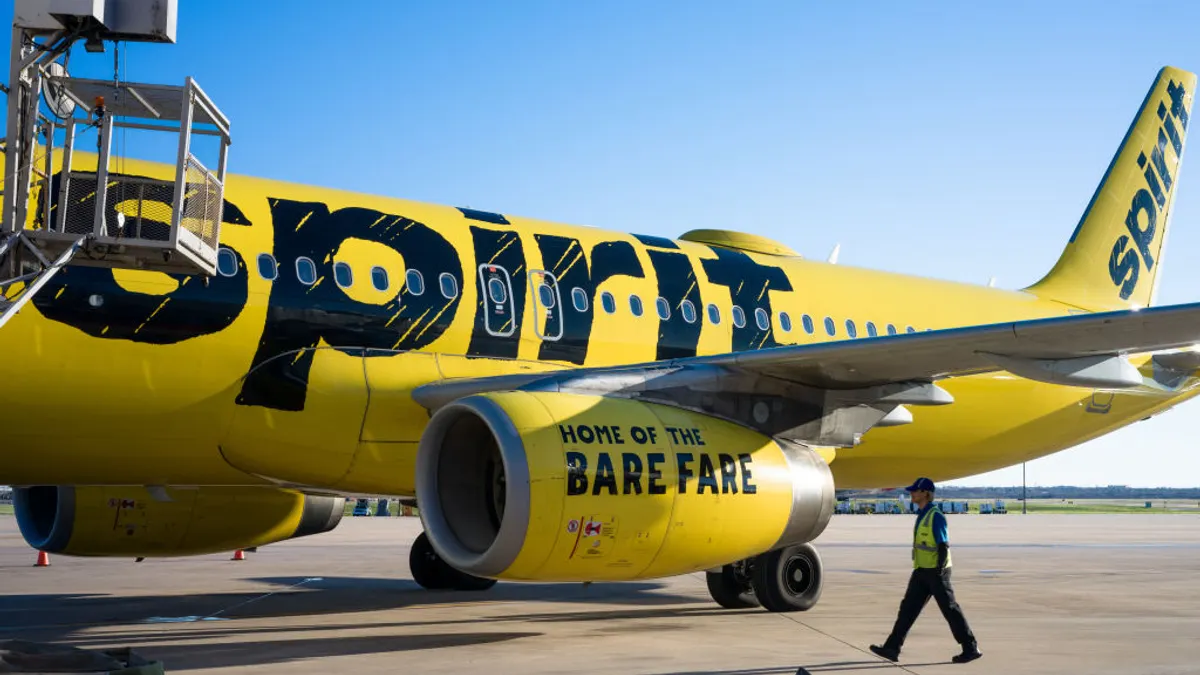
When Spirit Airlines ceased operations in May, its customers got little warning and even less support. The airline's contact centers and digital channels went dark alongside its fleet, leaving travelers scrambling to rebook on other carriers.
That came as no surprise to experts, as companies rarely plan for end-of-brand experiences. But how a company handles its customers can impact the value of assets in a sale and customer retention during a transition.
The right approach depends almost entirely on the type of shutdown, experts say.
In a full shutdown like Spirit's, managing CX is rarely the priority because the customer relationship is no longer valuable.
Companies facing financial distress are consumed by legal and financial obligations and customer claims, such as gift cards and loyalty rewards, fall near the bottom of the bankruptcy waterfall, said Gianfranco Finizio, a partner in the bankruptcy and restructuring department at the law firm Lowenstein Sandler.
"There's this awkward realization that in a bankruptcy, overnight, the customer becomes a creditor … and they’re last in line," Finizio said.
Attorney general pressure and goodwill considerations may keep those gift cards and loyalty rewards open for 30 to 60 days, but once the window closes, any unredeemed value becomes an unsecured claim with little chance of recovery.
How a company communicates that window, including proactively notifying members and setting clear deadlines, is one of the last CX decisions a dying brand can control.
Additionally, even when there's no business to save, CX leaders should still try to deliver a great experience, as it could affect their reputation and career prospects, with a poorly handled shutdown following them to their next venture.
"There are a lot of reasons to do the best you possibly can, even though you're not going to have a relationship with that customer after you stop operations,” said Phil Sager, a partner in the customer strategy & marketing and mergers & acquisitions practices at consultancy Bain & Company.
Mergers, acquisitions and rebrands
In a merger, acquisition or rebrand, the calculus changes completely because, when the customer base is an asset the acquirer paid for, a poor transition can destroy its value.
The first question CX leaders should ask is whether there's a gap between the old brand's positioning and the new brand's, according to Karen Lellouche Tordjman, managing director, senior partner and global leader for CX at Boston Consulting Group.
If the two brands promised customers a similar experience, such as price point or service level, the transition is mostly an execution challenge that requires customer data migration, clear communication and continuity.
When the positioning differs, however, companies face harder choices about which customer segments will carry over and which will not.
"Don't do it too bluntly because you have a risk in loyalty, and you have a reset," Tordjman said. "The customers are lost, and they feel like, ‘This is not the brand I'm used to.’"
In addition, while acquirers aren't legally required to honor legacy gift cards or loyalty programs, choosing not to often means starting with disgruntled customers.
"There is a big difference between what is legally required versus what is necessary to keep the brand and the goodwill intact," Finizio said.
Hudson's Bay Company is a textbook example of a deliberate wind-down done well, according to Sager. Last year, the 350-year-old Canadian retailer celebrated its history, ran end-of-brand sales, and created enough goodwill to sell its brand assets and intellectual property to Canadian Tire for over $21 million.
Common missteps and operational strains
The list of missteps that can come out of transitions and acquisitions is long — from assuming customers will remain loyal to underestimating operational strain.
Customers are "more fragile and willing to look at other options" during a brand transition, Tordjman said. As such, the acquiring brand needs to articulate its value proposition.
Companies also underestimate the operational strain of a merger, acquisition or rebrand on customer-facing channels.
"You usually have a peak of inbound calls and questions. Customers start calling because they know the brand is going to disappear, so they want to understand what happens to their account, their loyalty card or their reservation,” Tordjman said. “You need to manage the communication in a way that is not crazy costly, and that's why you need to have proactive communication."
Data migration is another pitfall, as losing customer history or mishandling opt-ins during a transfer to a new entity erodes the legacy brand's value, Tordjman said.
But the most common mistake is becoming internally focused as pressure builds, with teams consumed by questions about their own futures. So, the customer base — a potentially valuable asset — gets neglected, Sager said.
The most important advice is simple: CX leaders navigating the end of a brand need to anticipate how their customers will react and plan accordingly.
Or, as Sager put it, brands should "live out their commitment" to their customers — even at the end.